Loading...
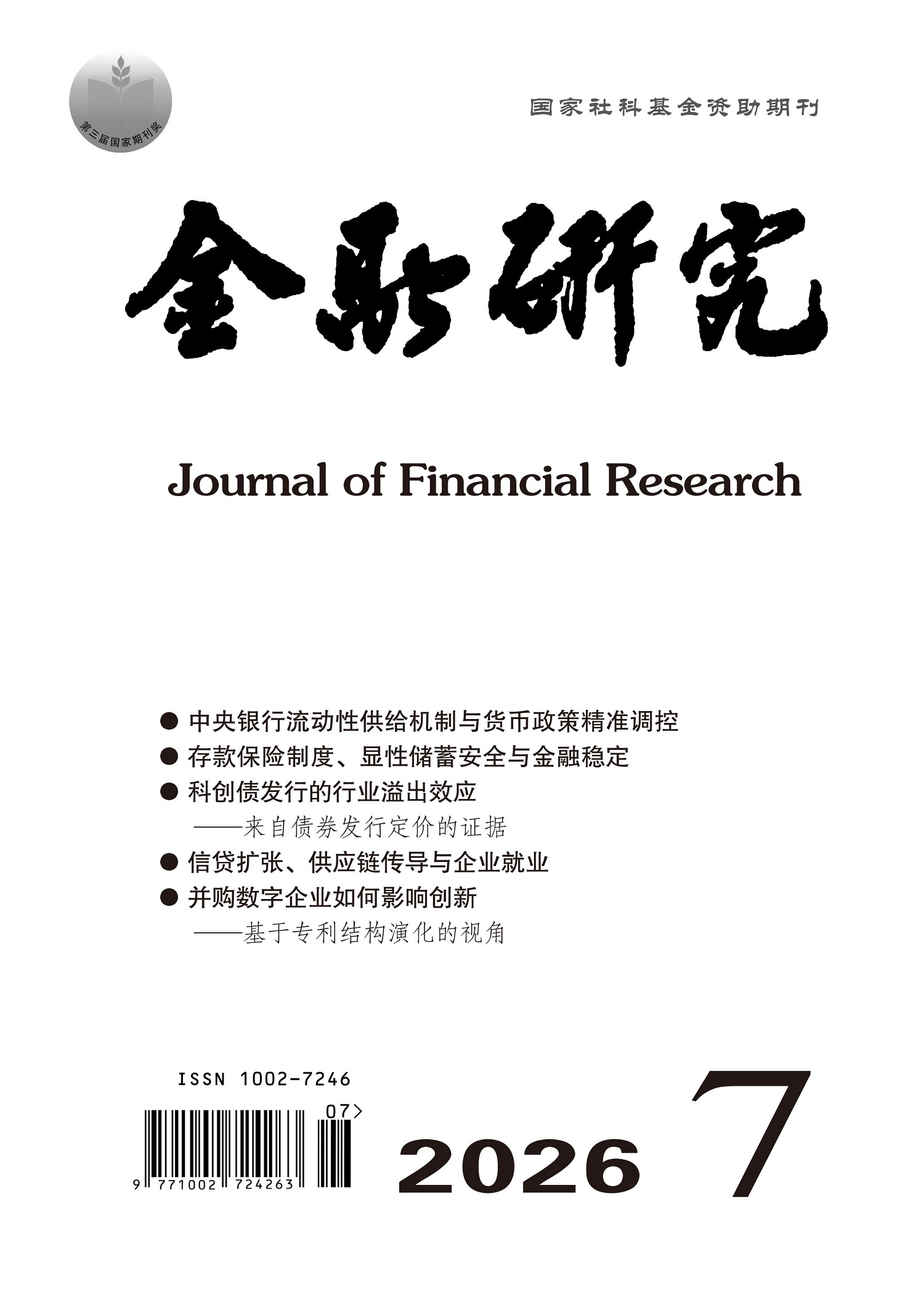
Cover Illustration
2026, Vol.553 No.7
Table of Content
25 July 2026, Volume 553 Issue 7
Previous Issue
Next Issue
For Selected:
View Abstracts
Download Citations
EndNote
Reference Manager
ProCite
BibTeX
RefWorks
Toggle Thumbnails
Select
Central Bank Liquidity Provision Mechanism and Monetary Policy Precision
Collect
ZHANG Chengsi, HE Qizhi, LIU Zehao
Journal of Financial Research. 2026,
553
(7): 1-19.
Abstract
(
930
)
PDF
(1564KB) (
3339
)
This paper addresses the major policy agenda of “establishing a well-conceived, prudent monetary policy system” in the new era. Starting from the central bank's liquidity provision mechanism, it examines the institutional foundation, operational logic, and reform direction of precise monetary policy implementation in China. In a modern credit-money system, central bank liquidity provision is essentially the provision of reserves to the banking system. Reserves constitute the foundation for payment settlement, money creation, and interbank transactions by commercial banks, and they are also a key variable in the formation of short-term money market rates. Unlike major advanced economies, where reserve supply is mainly adjusted through open market operations, the supply and structure of reserves in China are jointly affected by changes in foreign exchange funds outstanding, the required reserve ratio, and a broad range of liquidity instruments, including open market operations (OMOs), the medium-term lending facility (MLF), the standing lending facility (SLF), pledged supplementary lending (PSL), relending and rediscounting facilities, and treasury cash management. These arrangements have formed a highly diversified reserve supply system. Therefore, understanding the transformation of China’s monetary policy framework requires returning to the starting point of monetary policy implementation: how the central bank supplies reserves to the banking system, how reserves from different sources affect the supply and demand of excess reserves, and how this reserve supply structure changes the precision of short-term interest rate control under the interest rate corridor system.
Based on changes in the balance sheet items of the People’s Bank of China (PBOC), this paper first examines the linkage between reserve supply and the PBOC’s balance sheet operations. It incorporates into a unified analytical framework both the positive reserve supply channels, such as foreign exchange funds outstanding, claims on the government, claims on other depository corporations, and claims on other financial corporations, and the reserve-absorbing channels, such as currency issuance, government deposits, deposits of non-financial institutions, central bank bill issuance, and other liabilities. Using PBOC balance sheet data from 1997 to 2025, the paper documents the dynamic transformation of China’s reserve supply structure from one dominated by foreign exchange funds outstanding to one based on a combination of multiple liquidity instruments. The results show that, after 2014, as the growth of foreign exchange funds outstanding slowed and even experienced periodic contractions, the PBOC increasingly relied on active liquidity instruments such as OMO, MLF, and relending facilities to regulate reserve supply. China’s reserve supply mechanism thus shifted from a single-pillar structure dominated by foreign exchange funds outstanding to a dual-pillar structure jointly supported by foreign exchange funds outstanding and multiple liquidity instruments. This structural change has strengthened central bank’s capacity to adjust liquidity autonomously, but it has also created coordination challenges arising from differences in instrument maturities, operational targets, counterparties, and price signals.
On this basis, the paper constructs a simplified model linking reserve supply, reserve demand, and the money market benchmark rate. The model shows that, under a scarce-reserveregime and an interest rate corridor system, the central bank must accurately forecast and adjust the supply-demand balance of excess reserves in order to achieve precise control over short-term operational target rates such as DR007. The model indicates that when reserve supply shifts from being dominated by foreign exchange funds outstanding to being jointly determined by multiple instruments, the variance of interest rate control deviations may increase, making precise monetary policy implementation more difficult. When the central bank simultaneously undertakes multiple objectives, including stabilizing growth, maintaining price stability, safeguarding financial stability, and supporting structural adjustment, structural monetary policy instruments can help promote policy goals such as green finance, inclusive finance, and technology finance. However, their use also changes the aggregate amount of reserves in the banking system, thereby affecting short-term interest rate control. Thus, while a multi-instrument framework enhances policy flexibility, it may also weaken the forward-looking nature and consistency of interest rate corridor operations.
Empirically, the paper uses daily and monthly data from China’s interbank market from December 2014 to November 2025 to examine the effectiveness of interest rate corridor operations, the dynamic relationship between aggregate net liquidity injections and DR007, and the effects of the joint use of multiple liquidity instruments on DR007. The results show that when DR007 persistently deviates from the policytarget rate, the central bank usually responds through subsequent OMOs, indicating that open market operations have a relatively strong capacity for timely adjustment. However, the return of DR007 to the policy target rate is relatively slow, and deviations tend to persist for a considerable period, suggesting that there is still room to improve the persistence and forward-looking nature of policy operations. Further evidence from VAR and SVAR estimations, Granger causality tests, and impulse response analysis shows that there is no stable and significant dynamic predictive relationship between aggregate net liquidity injections and DR007, and that liquidity injection shocks have only a weak effect on DR007. When multiple liquidity instruments are included in the model simultaneously, the predictive effect of OMO net injection quantities on DR007 is generally insignificant, whereas the OMO reverse repo rate has a more significant predictive effect on DR007. It is worth noting that when the OMO net injection indicator is constructed either including or excluding the outright reverse repos and open market government bond transactions introduced by the PBOC after 2024, its impact on DR007 differs in statistical significance. This suggests that recent changes in the PBOC’s OMOs over the past two years have had subtle yet positive effects on market interest rates.
In terms of policy implications, China’s future monetary policy frameworkcan strike an institutional balance between continuing to improve reserve supply management and gradually strengthening reserve demand management. If China continues to rely on a scarce-reserve-based interest rate corridor system, it will be necessary to improve the forward-looking nature of liquidity provision, strengthen coordination among OMOs, MLF, structural instruments, changes in government deposits, and required reserve ratio adjustments, appropriately optimize the width of the interest rate corridor, enhance the signaling effect of the policy target rate, and reduce conflicts among the objectives of different instruments. If the required reserve ratio continues to decline, excess reserves continue to rise, and multiple liquidity instruments coexist over the long run, China may further consider establishing a reserve demand management framework centered on the interest rate on excess reserves. By anchoring the short-term interest rate more effectively, such a framework could reduce the interference of reserve supply complexity with interest rate control.
References
|
Supplementary Material
|
Related Articles
|
Metrics
Select
The Factor Income Distribution Effects of China's Monetary Policy: A Dual-Friction Perspective on the Labor and Financial Markets
Collect
FAN Zhiyong, AN Geyang, YANG Yixuan
Journal of Financial Research. 2026,
553
(7): 20-38.
Abstract
(
437
)
PDF
(1579KB) (
461
)
Since the global financial crisis, the link between accommodative monetary policy and income and wealth inequality has drawn extensive attention from both academia and policymakers. Beyond conventional aggregate economic effects, monetary policy may generate complex structural effects, for example, by influencing the relative use of capital and labor in the production process and thereby affecting the distribution of national income between these two factors of production. Globally, labor is generally more evenly distributed across households than capital, so a higher share of national income accruing to labor implies a narrowing of income disparities. In China, property income accounts for a very low share of residents’ total income while wage income is dominant. Thus, a rise in the labor income share carries important implications for reducing income inequality, enhancing people's sense of gain, and boosting consumption and domestic demand. At present, the external environment is becoming more complex and severe. To better consolidate the foundation for sustained economic recovery, China's monetary policy stance has shifted to “moderately accommodative.” The word “moderately” fully reflects the dynamic balance between counter-cyclical adjustment and cross-cyclical adjustment, and between stabilizing growth and preventing the entrenchment of structural problems under the macroeconomic governance system with Chinese characteristics. Against this backdrop, an in-depth study of the impact of expansionary monetary policy shocks on the labor income share is of great significance for understanding the potential structural shortcomings of monetary policy and for crafting a well-coordinated policy mix.
This paper studies the impact of monetary policy on the labor income share through the lens of dual frictions in the labor market and the financial market. We first construct a dynamic stochastic general equilibrium model incorporating both labor market and financial market frictions. The simulation results show that labor adjustment frictions, and the resulting difference in adjustment speeds between labor and investment, play a key role in how monetary policy affects the labor income share. In the absence of labor adjustment frictions, an expansionary monetary policy shock causes labor to adjust faster than investment, thereby raising the labor income share. Once labor adjustment frictions are introduced, labor adjusts more slowly than investment, thereby reducing the labor income share. Moreover, the magnitude of the impact of monetary policy on firms’ labor income share is also related to the degree of financial market frictions they face.
Building on the theoretical model, we use data on China's non-financial A-share listed firms from 2007 to 2023, identify monetary policy shocks with a high-frequency identification approach, and employ local projection methods to estimate the dynamic impact of monetary policy shocks on firms’ labor share. The empirical evidence shows: First, expansionary monetary policy shocks reduce firms’ labor income share. Second, the magnitude of this effect is related to the labor adjustment costs firms face, and after an expansionary monetary policy shock, labor adjusts more slowly than investment. Third, the negative effect of monetary policy shocks on firms’ labor income share is more pronounced for firms facing more severe credit constraints. These empirical findings support the theoretical model that simultaneously incorporates labor adjustment costs and financial frictions.
Compared with the existing literature, this paper makes three contributions. First, it constructs a theoretical framework in which monetary policy affects the labor income share through its impact on firms’ labor hiring and investment decisions, and examines how labor market frictions and financial frictions shape the distributional effects of monetary policy. Second, it provides dynamic empirical evidence on the impact of monetary policy on firms’ labor income share, enriching micro-level evidence on the distributional consequences of monetary policy. Third, it empirically tests the mechanisms proposed in the theoretical model from the perspectives of labor market frictions and financial frictions, thus providing empirical support for the model specification.
Based on the theoretical analysis and empirical findings of this paper, we propose the following three policy implications. First, we should maintain a moderately accommodative monetary policy stance, keep monetary policy properly calibrated, avoid broad-based flood-style easing. Monetary policy should actively perform its countercyclical adjustment function to provide a sound monetary and financial environment for economic stabilization and recovery; at the same time, it should prevent easing that is too large in scale or too prolonged from entrenching structural distortions. Second, we should promote the coordinated efforts of monetary policy and structural policies, such as fiscal, employment, and distribution policies, to forge an effective policy mix. The strength of monetary policy lies in its aggregate adjustment effects. This necessitates that, alongside the implementation of accommodative monetary policy, fiscal and tax policies be tilted toward front-line workers and low- and middle-income groups. Third, we should increase policy support for private enterprises and small and medium-sized enterprises (SMEs). Recruitment subsidies for private enterprises and SMEs hiring recent graduates should be increased, thereby providing stronger incentives for these firms to create and expand employment opportunities. Meanwhile, vocational skills training and occupational transition support should be improved to enhance workers’ adaptability to emerging technologies and advanced equipment, so as to achieve better coordination among capital deepening, employment expansion, and labor income growth.
References
|
Supplementary Material
|
Related Articles
|
Metrics
Select
Deposit Insurance System, Explicit Savings Security and Financial Stability
Collect
WANG Qing, YAO Shuai, SO Yukchow
Journal of Financial Research. 2026,
553
(7): 39-57.
Abstract
(
356
)
PDF
(753KB) (
253
)
Financial security is pivotal to the overall national economy and social stability. As a core pillar of the financial safety net, the explicit deposit insurance system is a crucial instrument for safeguarding financial stability. Protecting the safety of public savings is also the original intent and mission of implementing an explicit deposit insurance system. China's high savings rate and its strong resilience to economic fluctuations are the root causes of its robust risk-resistant capacity. This reality also constitutes a key reason why China needs to rely on an explicit deposit insurance system to fully safeguard public savings. In the context of China's accelerated advancement of deposit insurance system reform, it is necessary to explore the significant value of explicit savings security for maintaining financial stability. Existing literature predominantly focuses on its partial value for banking stability, leaving its comprehensive value for broader financial stability and the underlying transmission channels unexplored. There remain shortcomings in terms of research samples, measurement indicators, analytical perspectives, theoretical modeling, and empirical design.
Theoretically, this paper is the first to integrate the stability of both the banking sector and the non-bank sector into a unified analytical framework for studying savings security and financial stability. By introducing non-bank sectors and survival preferences, we extend the heterogeneous depositor equilibrium model of Dávila and Goldstein (2023). We treat banking sector stability as the direct perspective for examining financial stability, and non-bank financial sector stability as the spillover effect. The study investigates how the degree of explicit savings security affects financial stability through specific channels. Empirically, utilizing panel data from 60 countries spanning from 1985 to 2022 and employing a two-way fixed effects model, this paper examines the impact of explicit savings security on financial stability. The empirical results demonstrate that explicit savings security has a positive effect on financial stability. On the one hand, it functions as a “stability anchor” through direct effect channels that stabilize the banking sector and spillover effect channels that stabilize other financial sectors. On the other hand, it serves as a “trust anchor” through channels of government and social trust. Further research indicates that the financial stability effect of explicit savings security is more pronounced in countries with weaker implicit guarantee expectations and more evident shortcomings in their financial safety nets.
Compared to existing literature, this research makes four primary contributions. First, shifting from the broad concept of savings to a narrow concept of savings security, this paper thoroughly demonstrates the significant value of explicit savings security, based on deposit insurance coverage levels, for maintaining financial stability. Second, relevant research frequently concentrates on bank runs but less on runs in non-bank financial sectors, and fails to adequately discuss the roles of the “stability anchor” and “trust anchor” in safeguarding financial stability. This paper introduces interbank sectors and survival preferences into the model to explain the mechanism through which explicit savings security promotes financial stability by stabilizing both the banking and non-bank financial sectors. Third, existing studies tend to focus on the partial stability of banks rather than the overall stability of the financial system, lacking attention to relevant causal chains and mechanisms. There is also a scarcity of multinational evidence covering long time spans and various channels. This paper, combining long-term panel data from major global economies and employing robust estimation strategies, identifies empirical evidence that explicit savings security promotes financial stability through the “stability anchor” and “trust anchor” mechanisms. Fourth, our findings enrich the understanding of the narrow concept of savings security, particularly demonstrating the important practical value of the deposit insurance system and explicit savings security. This counters arguments of “nominal existence” or “ineffectiveness” regarding deposit insurance system construction, providing a basis for China to steadfastly develop a deposit insurance system with Chinese characteristics.
References
|
Supplementary Material
|
Related Articles
|
Metrics
Select
The Innovation-Driving Effect of Insurance Funds’ Market Entry: A Perspective on Fostering Patient Capital
Collect
WANG Xiuhua, LIANG Zhongqi, LIU Jinhua
Journal of Financial Research. 2026,
553
(7): 58-76.
Abstract
(
513
)
PDF
(924KB) (
503
)
Technological innovation is characterized by high risks, long cycles, and substantial sunk costs, which creates a natural mismatch with the short-term return orientation of traditional financial capital. In the context of accelerating high-level technological self-reliance, cultivating patient capital capable of traversing economic cycles and tolerating short-term trial-and-error has emerged as a critical strategic imperative. Characterized by large scale, long liability duration, and strong stability, insurance funds possess the intrinsic endowments to serve as patient capital. This paper investigates whether the market entry of insurance funds can exert their patient capital attributes to effectively drive substantive corporate innovation and explores the underlying mechanisms. Using the sample of A-share listed firms in China from 2005 to 2024, this study conducts systematic empirical tests with a two-way fixed effects model.
The results indicate that the market entry of insurance funds significantly enhances corporate innovation output. More importantly, this driving effect primarily manifests in promoting substantive innovation with high knowledge spillovers and technological barriers, rather than inducing firms to engage in low-quality strategic innovation to policy catering. Regarding micro-transmission mechanisms, insurance funds construct a three-dimensional pathway through resource allocation, market signaling, and failure tolerance. Specifically, the resource effect broadens direct financing channels and optimizes the credit maturity structure, thereby alleviating long-term financial constraints. The signal effect mitigates market volatility and boosts corporate valuation by acting as a market stabilizer and value certifier, which consequently reduces the information friction costs of external financing. The insurance effect mitigates executive career concerns by reducing the sensitivity of compensation and turnover to short-term performance, providing institutional guarantees for risk-taking.
Group analysis further reveals that the innovation-driving effect of insurance funds is more pronounced in firms with higher R&D investments, smaller market shares, and those in their growth or maturity stages. Furthermore, additional analyses find that facing the high sunk costs of key core technology research and development, insurance funds enable firms to undertake more disruptive and original innovations in key digital technologies, serving as a vital force in helping firms overcome technological bottlenecks.
The marginal contributions of this paper are reflected in three dimensions. First, from a theoretical perspective, aligning with the policy imperative of fostering patient capital, this paper provides a novel theoretical interpretation of the patient capital attributes of insurance funds, thereby expanding the research horizon of science and technology finance. Second, regarding the mechanisms, this study disentangles how insurance funds empower innovation, confirming its operation through a three-dimensional pathway of resource, signal, and insurance effects. Third, in terms of empirical evidence, this paper refines the structural characteristics of innovation output and reveals the unique value of insurance funds in driving substantive innovation and breakthroughs in key digital technologies.
Based on these findings, this paper proposes a series of policy implications. Regulatory authorities should further optimize the institutional environment to accommodate the characteristics of long-term capital, comprehensively promote long-cycle performance assessment mechanisms, and refine solvency regulatory rules. Concurrently, insurance asset management institutions should be encouraged to establish specialized products focusing on key core technologies and to explore a comprehensive service model combining equity investment and technology insurance. In addition, insurance funds should be guided to actively participate in corporate governance to foster internal incentive systems that tolerate failure. Policies also need to support insurance funds in broadening investment channels in early-stage and hard-technology sectors. While persisting in guiding long-term market entry, penetrative supervision must be strengthened to prevent short-term speculative risks.
References
|
Supplementary Material
|
Related Articles
|
Metrics
Select
The Industry Spillover Effects of Science and Technology Innovation Bond Issuance: Evidence from Bond Pricing
Collect
LIU Yingfei, LI Haofei, LIN Wanfa, ZHU Xiaoquan
Journal of Financial Research. 2026,
553
(7): 77-94.
Abstract
(
549
)
PDF
(549KB) (
865
)
Building a science and technology finance system aligned with innovation-driven development is pivotal to achieving high-level technological self-reliance. Despite policy efforts, structural deficiencies persist in China's science and technology finance landscape, notably insufficient bank lending to technology firms, limited equity market depth, and the nascent development of high-yield bonds. These gaps leave asset-light and high-risk firms facing severe financing frictions. In response, the bond market launched pilot programs for science and technology innovation bonds (sci-tech bonds) in March 2021, culminating in the establishment of a dedicated “sci-tech board” in May 2025. While prior research has extensively documented the direct benefits for issuing entities, it has largely neglected whether such policies generate positive externalities that spur collaborative innovation among non-sci-tech firms. Employing a sample of exchange-traded public corp orate bonds from 2020 to 2023, this study utilizes a multi-period staggered difference-in-differences framework to examine the intra-industry spillover effects of sci-tech bond issuance, the underlying mechanisms, and the boundary conditions. Our findings offer empirical support for optimizing the provision of technology finance and refining the institutional design of the bond market's sci-tech board.
First, we document significant positive intra-industry spillovers. A one-standard-deviation increase in the monthly ratio of Sci-Tech Bonds to total industry issuances reduces the yield spreads of non-Sci-Tech Bonds by approximately 5.15 basis points, equivalent to a 4% decline relative to the sample mean. This result proves robust to a battery of tests, including instrumental variable estimation, matched sample analysis, and parallel trend validation, effectively mitigating selection bias concerns. Second, the spillover operates through two distinct channels: (1) R&D Learning. Sci-tech bond issuance disseminates credible technological roadmaps, prompting peer firms to upgrade R&D intensity and technical staff. By reducing R&D uncertainty, the expected mean cash flow effect of innovation outweighs the variance effect, thereby lowering the risk premium required by creditors. (2) Information Asymmetry Mitigation. Stringent disclosure mandates and heightened market scrutiny increase the aggregate supply of industry-specific R&D information. Via peer effects, non-sci-tech firms are incentivized to enhance the quality of R&D disclosures in prospectuses and rating reports, which narrows the primary-secondary market pricing gap and improves price efficiency. Third, heterogeneity analysis reveals that the spillover is more pronounced in settings characterized by higher default risk, stronger banking supervision, bottlenecks, direct project funding, lower credit ratings, longer maturities, and the absence of R&D manipulation.
This study contributes to the literature by pioneering the analysis ofsci-tech bonds from a spillover perspective, balancing the existing focus on green bonds, and providing micro-level evidence on industry linkage mechanisms in innovation incentives. We suggest improving the sci-tech board framework, offering targeted incentives for long-term issuance in bottleneck sectors, and enforcing rigorous oversight of fund usage and R&D authenticity to curb manipulative behaviors.
References
|
Supplementary Material
|
Related Articles
|
Metrics
Select
Information Asymmetry, Climate Adaptation Investment Gap and Financial Regulatory Policy Response
Collect
CHEN Guojin, ZHAO Yulei, ZHAO Xiangqin
Journal of Financial Research. 2026,
553
(7): 95-113.
Abstract
(
326
)
PDF
(678KB) (
265
)
The national climate change adaptation strategy 2035 identifies mitigation and adaptation as the two complementary and indispensable strategies for addressing climate change. While research on mitigation, centered on carbon emission reduction, has become extensive and in-depth, the worsening climate risks, marked by increasingly frequent and severe climate disasters, have created an urgent and pressing need for research on adaptation, which focuses on building resilience to physical climate risks. Yet adaptation research remains scarce, both in its theoretical foundations and its empirical evidence. A crucial aspect of adaptation is narrowing the climate adaptation investment gap. Climate adaptation investment encompasses all activities that strengthen resilience to physical climate risks, aiming to reduce future economic and social losses from climate disasters. The climate adaptation investment gap specifically refers to the shortfall between the amount of investment required to achieve a targeted level of resilience against physical climate risks and the actual investment that can be mobilized in practice. In reality, a substantial gap persists, posing serious threats to sustainable development.
This paper focuses on a key private sector setting in which firms undertake climate adaptation investments and banks provide the credit to finance them. Given that firms exhibit heterogeneous levels of exposure to climate disasters, their adaptation needs and corresponding investment approaches differ considerably. Consequently, when firms seek credit for adaptation investments, banks face severe information asymmetry if they cannot effectively observe and assess firms’ real adaptation needs and the specific investments required. This information asymmetry, often leading to moral hazard problems in the credit market, may be a critical driver of the observed adaptation investment gap.
Building on this setting, we construct a theoretical model in which a firm simultaneously finances two types of investments through bank credit: productive investment and climate adaptation investment. In the model, depositors, banks, and the firm sign loan contracts for both investment types. Given the presence of information asymmetry in both types of investments, banks monitor both activities. We then examine how information asymmetry in adaptation investment shapes the investment gap and explore how financial regulatory policies can address this market failure, along with their theoretical underpinnings.
The theoretical analysis yields three main findings. First, deeper information asymmetry in adaptation investment intensifies moral hazard, preventing the optimal level, which is relatively high, of adaptation investment from obtaining a loan contract, thereby creating the adaptation investment gap. Second, greater bank monitoring effort can boost firms’ adaptation investment by mitigating information asymmetry, yet the gap persists even under the optimal choice of monitoring effort. Third, when the current level of adaptation is low (high), a reduction (increase) in the credit risk weight for such loans under financial regulatory policy induces banks to increase monitoring effort, thereby narrowing the investment gap. Moreover, this policy effect strengthens (weakens) over time, suggesting a dynamic adjustment mechanism. These theoretical findings are empirically validated.
This paper makes three contributions to the literature. First, it provides an analytical framework for studying credit financing issues, especially information asymmetry, when firms seek to build resilience to physical climate risks. Second, through the lens of information asymmetry, a foundational concept in corporate finance, the paper uncovers the mechanism generating the adaptation investment gap and reveals how bank monitoring influences the gap, thereby enriching our understanding of its determinants. Third, it elucidates the specific mechanism through which financial regulatory policy affects the adaptation investment gap, traces its dynamic evolution over time, and clarifies the policy's exit strategy. These insights provide a useful reference for central banks that seek to advance climate adaptation, with a focus on building resilience to physical climate risks.
References
|
Supplementary Material
|
Related Articles
|
Metrics
Select
Physical Climate Shocks, Local Government Debt Risk, and Real Economic Fluctuations
Collect
DING Pan, LI Li, LI Xiangyang
Journal of Financial Research. 2026,
553
(7): 114-132.
Abstract
(
403
)
PDF
(1588KB) (
410
)
In recent years, China has experienced increasing frequency of extreme weather events, and the adverse impacts of climate change on high-quality economic development and the stable operation of the financial system have become increasingly prominent. Meanwhile, the accumulation of local government debt risk has emerged as one of the major sources of systemic financial risk in China. By the end of 2024, the outstanding balance of implicit local government debt had reached RMB 10.5 trillion, much of which was financed through local government financing vehicles (LGFVs). As of December 2025, the interest-bearing liabilities of LGFVs amounted to RMB 68.86 trillion, local government debt levels in some regions remained considerably high. increasingly frequent and severe extreme weather events, post-disaster reconstruction and corporate relief efforts rely heavily on local public expenditure. Excessive debt burdens may crowd out local fiscal space and weaken disaster prevention and relief capacity, thereby further amplifying the adverse effects of extreme weather on the real economy. In this context, clarifying the compounded effects of physical climate shocks and local government debt risk, as well as the corresponding policy responses, is of great significance for China in stabilizing growth and preventing risksamid intertwined macroeconomic and financial risks. Motivated by this, this paper develops a New Keynesian DSGE model and constructs a provincial-level extreme precipitation series based on daily precipitation data from meteorological stations in China from January 1990 to December 2023, matching these data with LGFV bond and listed company financial data. Through this approach, this paper systematically examines, from both theoretical and empirical perspectives, the impact of physical climate shocks on real economic fluctuations under the continuous accumulation of local government debt risk, as well as the corresponding macro-policy responses.
On the theoretical side, we construct a New Keynesian DSGE model incorporating households, private firms, LGFVs, retailers, financial intermediaries, and local governments. Theoretical simulations and counterfactual analyses further support the empirical findings. Under scenarios of rising local government debt risk, physical climate shocks generate substantially larger contractionary effects on output, consumption, investment, and corporate credit. Welfare analysis further shows that macroprudential policies involving differentiated risk provisioning for LGFV-related loan assets can improve social welfare. Moreover, the combination of countercyclical macroprudential policies and central bank liquidity support can further enhance welfare outcomes.
This paper employs a sample of Chinese A-share listed firms from 2013 to 2023. The empirical results showthat the accumulation of local government debt risk significantly amplifies the inhibitory effect of physical climate shocks on corporate investment. Under a one-unit increase in physical climate shocks, firms located in provinces with relatively high local government debt risk experience an additional 6.13% decline in investment compared with firms in provinces with relatively low debt risk. Mechanism analyses indicate that this amplification effect mainly operates through the corporate balance sheet channel and the bankfirm information asymmetry channel. On the one hand, the interaction between physical climate shocks and local government debt risk significantly weakens firms’ market valuation, depresses Tobin's Q, and raises debt financing costs, thereby crowding out corporate investment. On the other hand, the compounded effects of physical climate shocks and local government debt risk intensify information frictions between banks and firms, particularly among opaque firms lacking executives with banking backgrounds or exhibiting higher analyst forecast dispersion, thereby strengthening financing constraints and further suppressing investment.
The marginalcontributions of this paper are threefold. First, we construct a climate shock series for China and reveal the amplification effect of local government debt risk on physical climate shocks. Second, at the micro level, we further investigate the transmission channels of this amplification effect, namely the deterioration of corporate balance sheets and the intensification of bankfirm information asymmetry. Third, we systematically evaluate the regulatory effects of , central bank liquidity support, and countercyclical macroprudential policies under the compounded effects of local government debt risk and physical climate shocks, thereby providing quantitative references for enhancing the consistency of macroeconomic policy coordination. Future research may further incorporate climate transition risk and climate risk into a unified analytical framework to more comprehensively identify and characterize the interaction of compounded risks. In addition, incorporating spatial spillover effects and cross-regional fiscal linkage mechanisms would help deepen the understanding of regional heterogeneity and risk transmission pathways.
References
|
Supplementary Material
|
Related Articles
|
Metrics
Select
Digital Transformation of Government and Firms’ Reallocation from Financialization to the Real Economy: An Analysis Based on Investment Structure Bias
Collect
WANG Ao, SUN Weizeng, ZHANG Qilin, PENG Yuchao
Journal of Financial Research. 2026,
553
(7): 133-150.
Abstract
(
516
)
PDF
(590KB) (
700
)
In recent years, the rising tendency of corporate financialization has become a prominent structural challenge to the development of the real economy in China. While firms increasingly allocate resources to financial assets, real investment has been relatively crowded out, potentially undermining long-term productivity growth, innovation capability, and economic resilience. Existing studies have emphasized policy incentives such as subsidies and tax reductions as tools to encourage firms to invest in the real economy. However, such direct interventions may distort market signals and reduce investment efficiency. Against this background, this paper explores whether the government digital transformation, an institutional reform driven by digital technologies, can guide firms to reallocate resources from financial assets back to real investment without relying on direct interventions.
This study incorporates digital government development into a unified analytical framework of firms’ investment structure choices. We construct a theoretical model in which firms optimally allocate their resources between real and financial investment under financing constraints, institutional transaction costs, and uncertainty. In the model, digital government development affects firms’ investment decisions through multiple channels, including reducing institutional transaction costs, easing financing constraints, lowering uncertainty perceptions, and improving expected returns on real investment. The theoretical analysis yields clear comparative statics predictions regarding the impact of digital government on firms’ total investment scale and investment structure.
To empirically test these predictions, we combine data on Chinese A-share listed firms from 2017 to 2022 with detailed information fromannual work reports of local government websites. A comprehensive index of digital government development is constructed to reflect the extent of digital transformation in local governance. Firm-level investment structure is measured by distinguishing between real investment and financial asset allocation. The empirical strategy controls for firm characteristics, regional factors, firm fixed effects, and region-by-year fixed effects.
The main findings are as follows. First, digital government development significantly increases firms’ overall investment scale. More importantly, it promotes real investment while restraining excessive financial asset allocation, thereby facilitating firms’ reallocation from financialization toward the real economy. This effect remains robust across alternative specifications and variable definitions.
Second, mechanism analyses show that digital government development operates through several key channels. Specifically, digital government significantly reduces firms’ institutional transaction costs by improving administrative efficiency, standardizing approval procedures, and enhancing transparency. It also alleviates financing constraints by improving information sharing between firms and financial institutions and by strengthening credit infrastructure. In addition, digital government reduces the perceived policy uncertainty of firms through greater policy transparency and predictability, while simultaneously improving the expected returns on real investment by providing more timely and accurate information on industrial policies, market demand, and economic conditions.
Third, heterogeneity analyses reveal that the positive effect of digital government on firms’ reallocation toward real investment is more pronounced for non-state-owned firms, smaller firms, firms in strategic emerging industries, and firms with higher levels of digitalization. At the regional level, the effect is stronger in areas with higher marketization, more developed financial systems, and better digital infrastructure. These findings suggest that digital government development complements market mechanisms and institutional environments, amplifying its impact in regions where firms are more responsive to improvements in governance quality.
Fourth, further analyses indicate that digital government development helps alleviate firms’ underinvestment problems, enhances investment efficiency, and restrains short-term, liquidity-driven investment behavior. By improving the investment environment rather than directly intervening in firms’ decisions, digital government encourages firms to adopt a longer-term perspective and allocate resources more efficiently.
Overall, this study makes three main contributions. First, it extends the literature on corporate investment by highlighting the role of government digital transformation as an institutional determinant of firms’ investment structure. Second, it provides a systematic theoretical framework and empirical evidence on how digital government influences both the scale and composition of firm investment. Third, it offers important policy implications by showing that digital government development represents an effective governance approach to promoting the real economy while preserving market efficiency. These findings underscore the importance of advancing digital government construction as a key component of modern governance and high-quality economic development in the digital economy era.
References
|
Supplementary Material
|
Related Articles
|
Metrics
Select
Credit Expansion, Supply Chain Transmission, and Firm Employment
Collect
WANG Xianbin, CHEN Keyu
Journal of Financial Research. 2026,
553
(7): 151-169.
Abstract
(
396
)
PDF
(687KB) (
328
)
Employment stability and effective monetary policy transmission are central issues in China's macroeconomic governance. Credit expansion is commonly expected to promote employment by easing firms' financing constraints and stimulating investment. However, in production networks, the employment effects of credit may not be confined to the borrowing firm itself. Credit obtained by a core customer can also affect upstream suppliers through supply-chain relationships. Therefore, this paper investigates whether the credit expansion of core customers promotes supplier employment, and explores the mechanisms through which this spillover takes place.
This paper develops a “Signal Transmission to Strategic Response” framework within a production network setting. The key argument is that bank credit is not only a financial resource, but also a credible signal. Given that banks screen and monitor borrowers before extending loans, a customer's access to credit can reveal information about its future growth prospects, business stability, and competitiveness. Upstream suppliers observe this signal, update their expectations about future cooperation, and may adjust their employment before actual orders arrive. In this sense, credit expansion is transmitted along supply chains not only through the flow of funds or physical orders, but also through information and expectations.
Using matched supplier-customer data from Chinese A-share listed firms over the period of 2007-2024, this paper examines how credit expansion by a supplier's largest listed customer affects the supplier's employment. Supplier employment is measured as the natural logarithm of total employees, while customer credit expansion is measured as the log of bank loans by the primary customer. The baseline specification controls for firm fixed effects, year fixed effects, and lagged firm-level covariates. To address potential endogeneity, the paper constructs a Bartik-style instrumental variable by interacting the customer's initial firm size with city-level credit supply conditions.
The empirical results show that customer credit expansion significantly increases supplier employment. This finding remains robust after applying the instrumental variable strategy, using alternative measures of customer credit, and controlling for the supplier's own borrowing. Mechanism tests further support the proposed framework. On the customer side, credit expansion is associated with increased capacity investment and higher market value, consistent with the release of signals about future growth and competitive strength. On the supplier side, suppliers respond by increasing selling expenses and reducing precautionary cash holdings, indicating proactive operational and financial adjustments that lay the groundwork for subsequent employment expansion.
The paper further distinguishes the signaling mechanism from contemporaneous order transmission. After controlling for customer's revenue growth, cost growth, and asset growth, the effect of customer borrowing on supplier employment remains significant. This suggests that the employment effect does not rely entirely on real business expansion or increased procurement demand; rather, the information content of customer credit has independent explanatory power. Heterogeneity analysis shows that the effect is stronger among highly customer-dependent, non-state-owned, and labor-intensive suppliers. It is further amplified when the customer occupies a more central position in the production network and when the supplier has stronger business ties with the customer. This indicates that both the credibility of the signal source and the supplier's motivation to respond jointly determine the strength of credit transmission.
To evaluate the aggregate employment implications of this micro-level mechanism, this paper embeds the credit shock into a general equilibrium model with production networks and conducts counterfactual simulations based on China's input-output structure. The results show that production networks amplify the employment effects of credit shocks, and that industries with higher network exposure experience larger indirect effects. This macro-level evidence complements the micro-level findings and highlights the structural role of production networks in transmitting credit shocks to employment.
This paper contributes to the literature by identifying an information transmission channel that complements the traditional resource allocation view of the credit policy. It extends the analysis of firm employment decisions from a single-firm perspective to a production network perspective, and connects micro-level causal evidence with macro-level counterfactual analysis. The findings suggest that credit policy should not only focus on the borrowing firms themselves, but also consider how credit signals travel through supply chains and affect employment decisions among connected firms. Strengthening supply-chain finance, identifying key firms in production networks, and improving the transmission efficiency of credible credit information may enhance the employment-stabilizing effects of the monetary policy.
References
|
Supplementary Material
|
Related Articles
|
Metrics
Select
Can Corporate Limited Partners Provide Patient Capital? Evidence from China's Private Equity Market
Collect
ZHOU Xiangyi, YAO Yao
Journal of Financial Research. 2026,
553
(7): 170-188.
Abstract
(
375
)
PDF
(560KB) (
307
)
In recent years, providing long-term and stable funding for technological innovation has become an important issue in China. Early-stage technology firms usually face long R&D cycles, high investment needs, and high commercialization risks, and therefore rely on patient capital that focuses on long-term value rather than short-term returns. Whether an investment can be regarded as patient capital depends fundamentally on whether investors pursue long-term value rather than short-term gains. Non-financial firms are important investors in China's private equity market, but existing studies mainly focus on corporate venture capital (CVC), namely direct investments in startups for strategic purposes. Much less is known about non-financial firms’ role as limited partners (LPs) in venture capital funds. This paper examines whether corporate LPs can provide patient capital, how this role differs across different types of corporate LPs, and how their investment performance varies.
Existing studies often measure patient capital based on investors’ holding periods, turnover, or governance participation in secondary markets. In private equity markets, however, actual holding periods are often affected by IPO approval procedures, exit channels, and capital market cycles. Therefore, they may not accurately reflect investors’ subjective patience. Accordingly, this paper starts from investors’ active choice of project types and uses the share of early-stage technology projects invested in by LP-backed funds as the main measure of LP patience.
This paper collects LP information, fund investment and exit events from the Zero2IPO database, a leading commercial database on private equity investment in China, and constructs an LP-fund level dataset from 2000 to 2022. It then obtains granted invention patent data from the China National Intellectual Property Administration and matches them with corporate LPs, portfolio firms, and CVC parent companies. The comparison between CVC and corporate LP investments shows that CVC emphasizes deep technological and strategic collaboration with portfolio firms, while corporate LP investment is broader in nature. Specifically, startups backed by corporate LPs have lower technological similarity with the LPs themselves, but higher shares of early-stage and technology-oriented projects.
The empirical results show that corporate LP-backed funds invest more in early-stage technology projects than funds backed by non-corporate LPs, suggesting that corporate LPs are more patient. This pattern is even stronger among high-technology corporate LPs, whose funds allocate more to early-stage and technology-oriented projects, and invest in startups with higher innovation intensity. Although state-owned enterprise (SOE) LPs do not show a stronger preference for early-stage technology projects overall, those SOE LPs in high-technology industries clearly favor early-stage technology projects. As for performance, funds backed by high-technology corporate LPs have lower exit and IPO rates. Further analysis shows their reinvestment decisions are weakly related to short-term financial outcomes such as exit and IPO rates, consistent with their strategic investment motives.
This paper makes two main contributions. First, it provides evidence on the sources of patient capital in China's private equity market. By measuring LP patience with the share of early-stage technology projects invested by LP-backed funds, the paper shows that high-technology corporate LPs are the most patient, and that state-owned corporate LPs in high-technology industries also tend to support early-stage technology projects. Second, the paper extends the literature on non-financial firms’ participation in private equity. By comparing CVC with corporate LP investment, it shows that CVC focuses more on technological and strategic synergies, while corporate LP investment is broader in scope, helping explain firms’ motives for investing as LPs.
Based on these findings, this paper offers three policy implications. First, high-technology state-owned enterprises should be encouraged to act as LPs in early-stage technology funds and support portfolio firms with industrial resources, while adopting longer evaluation horizons for strategic projects. Second, tax incentives should be provided to corporate LPs investing in early-stage hard-tech firms to improve long-term returns and guide capital toward key sectors. Third, secondary transfer and exit mechanisms should be improved to reduce liquidity pressure on corporate LPs and strengthen their ability to continuously support early-stage technological innovation.
References
|
Supplementary Material
|
Related Articles
|
Metrics
Select
How Does Acquiring Digital Firms Affect Innovation: Evidence from the Perspective of Patent Structure Evolution
Collect
LUO Zhi, WANG Yangzi, WANG Yijing, DING Yucheng
Journal of Financial Research. 2026,
553
(7): 189-206.
Abstract
(
412
)
PDF
(1205KB) (
515
)
With the rapid development of the digital economy, mergers and acquisitions (M&As) have increasingly become an important strategic tool for firms to acquire external resources and enhance innovation capability. In recent years, M&A transactions targeting digital firms have expanded substantially in China and have gradually become an important force reshaping firms’ innovation behavior and industrial competition patterns. Compared with conventional firms, digital firms possess distinctive digital resources, including data assets, digital technologies, platform ecosystems, and digital talents. These resources are characterized by scalability, modularity, interoperability, and cross-scenario applicability, enabling firms to integrate heterogeneous resources more efficiently and enhance innovation activities through digital collaboration. Therefore, an important question is whether acquiring digital firms generates stronger innovation effects than acquiring non-digital firms and through what mechanisms these effects occur.
Existing studies have examined the relationship between digital transformation, M&A activities, and corporate innovation. However, important gaps remain. Some studies regard digital M&A mainly as a means of facilitating digital transformation but pay insufficient attention to the underlying process of resource acquisition and integration. Other studies directly analyze the role of digital resources while overlooking digital firms as the organizational vehicles through which such resources are obtained. Moreover, most existing literature relies on traditional indicators such as patent quantity or quality to measure innovation outcomes. While these indicators capture changes in innovation performance, they may fail to identify structural changes in firms’ technological systems and knowledge allocation patterns.
To address these limitations, this paper investigates the impact of acquiring digital firms on innovation from the perspective of patent structure evolution. We argue that the value of digital M&As lies not only in increasing innovation output but also in reshaping the organization and allocation of innovation activities across technological domains. Patent structure evolution provides a more comprehensive perspective because it reflects changes in technological breadth, specialization, and knowledge allocation patterns.
Using Chinese A-share listed firms from 2008 to 2022, this paper combines information from the Zephyr global M&A database, patent records from the China National Intellectual Property Administration, and firm-level financial data from CSMAR. A difference-in-differences framework is employed to estimate the causal effects of digital M&As, and multiple robustness and endogeneity tests are conducted.
The empirical findings reveal several important results. First, acquiring digital firms significantly promotes corporate innovation. Firms engaging in digital M&As experience increases in both total patent applications and digital patent output, and these effects are significantly stronger than those associated with traditional M&A activities. Second, digital M&Aspromote the simultaneous expansion of innovation in both breadth and depth. Specifically, corporate innovation activities gradually expand into a broader technological coverage across upstream and downstream industrial-chain activities, while concurrently building deeper digital technology accumulation and improving technological complexity and impact. Third, digital resource acquisition serves as the primary mechanism through which digital M&As affect innovation. Different types of digital resources also play distinct roles in the innovation process. Platform ecosystem resources contribute more strongly to increases in innovation output, whereas digital technologies play a greater role in optimizing innovation structure and enhancing technological depth. Furthermore, stronger innovation effects are observed among non-state-owned firms, firms acquiring technologically advanced targets, and firms operating in regions with stronger intellectual property protection and more competitive market environments.
This paper contributes to the literature by establishing an integrated framework linking digital firms, digital resources, and innovation outcomes, and by extending innovation measurement from conventional indicators to patent structure evolution. The findings suggest that policymakers should improve mechanisms for identifying and allocating digital assets and provide institutional support for efficient resource integration. Firms should place greater emphasis on strategic matching and resource complementarity in digital M&A activities. Future research may further investigate the long-term effects of digital M&As on technological trajectories and organizational transformation.
References
|
Supplementary Material
|
Related Articles
|
Metrics
京ICP备11029882号-1
Copyright © Journal of Financial Research, All Rights Reserved.
Powered by Beijing Magtech Co. Ltd